The Professional Guide to Back and Lay Betting: Mastering Exchange Mechanics
In the evolving landscape of sports trading, the traditional bookmaker model is rapidly being supplemented by the Peer-to-Peer (P2P) Exchange. While traditional betting is a one-way street, you against the house. the betting exchange is a two-way market. To navigate this successfully, a user must move beyond simple “betting” and understand the mechanics of Backing and Laying.
This 2,000-word masterclass breaks down the mathematical foundations of exchange markets, the critical concept of liability, and the advanced strategies used by professional traders in 2026.
1. The Architecture of a Betting Exchange
A betting exchange, such as BetPro Exchange, does not set odds. It is a technology provider that facilitates a marketplace.
Peer-to-Peer Matching
In a traditional sportsbook, the “house” takes the opposite side of every bet. In an exchange, if you want to bet 1,000 PKR on the Lahore Qalandars to win, the exchange must find another user (or group of users) willing to bet 1,000 PKR that the Qalandars will not win.
The Disappearance of the “Vig”
Traditional bookmakers build a profit margin (the “overround” or “vig”) into their odds. For example, in a 50/50 coin toss, a bookie might offer odds of 1.90 for both sides. The 0.10 difference is their guaranteed profit. On an exchange, users offer “True Prices.” You might see 2.00 for both sides, with the exchange taking a small 2% commission only on the net profit. This transparency is why exchanges are the preferred tool for professional analysts.
2. Back Betting: The Foundation
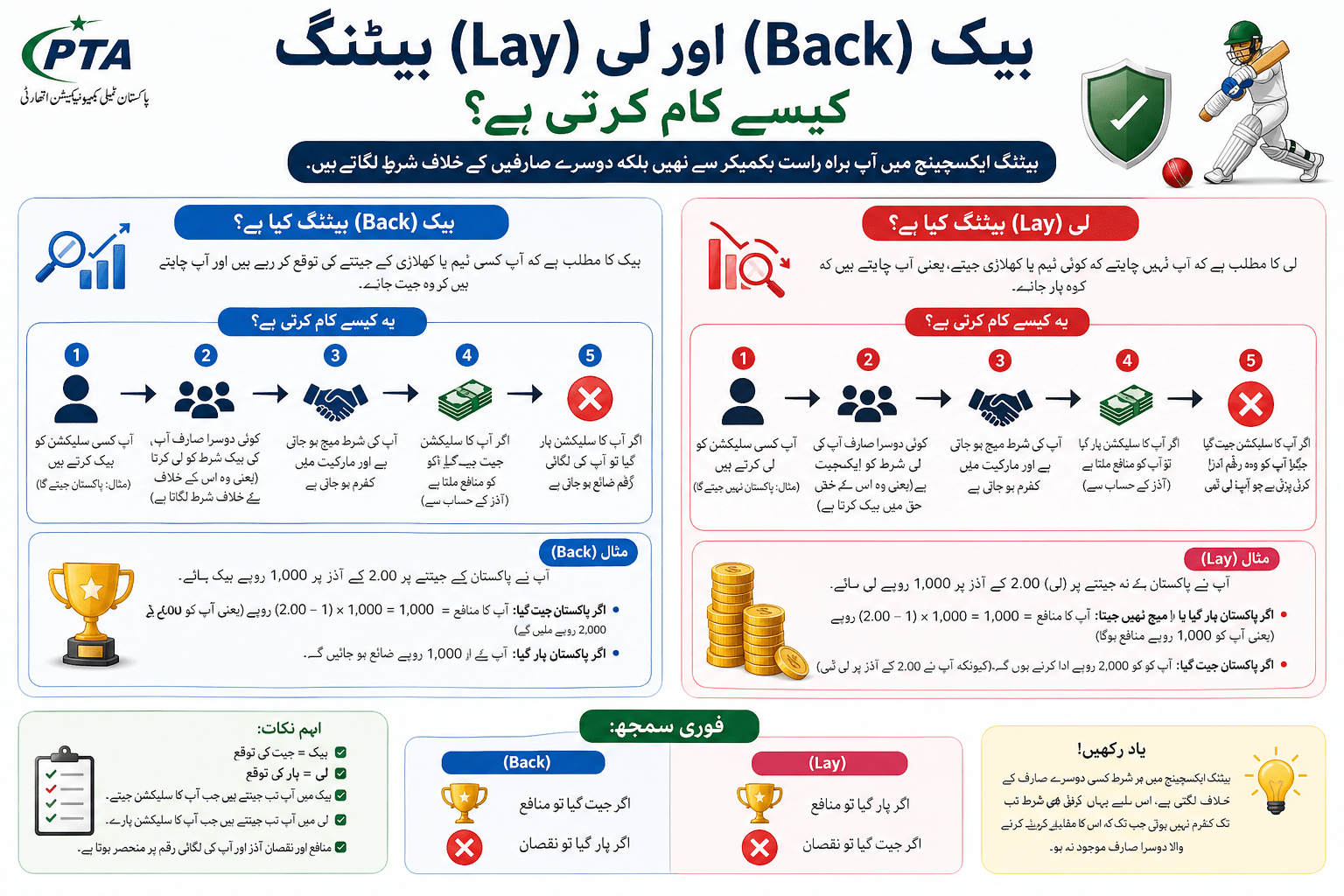
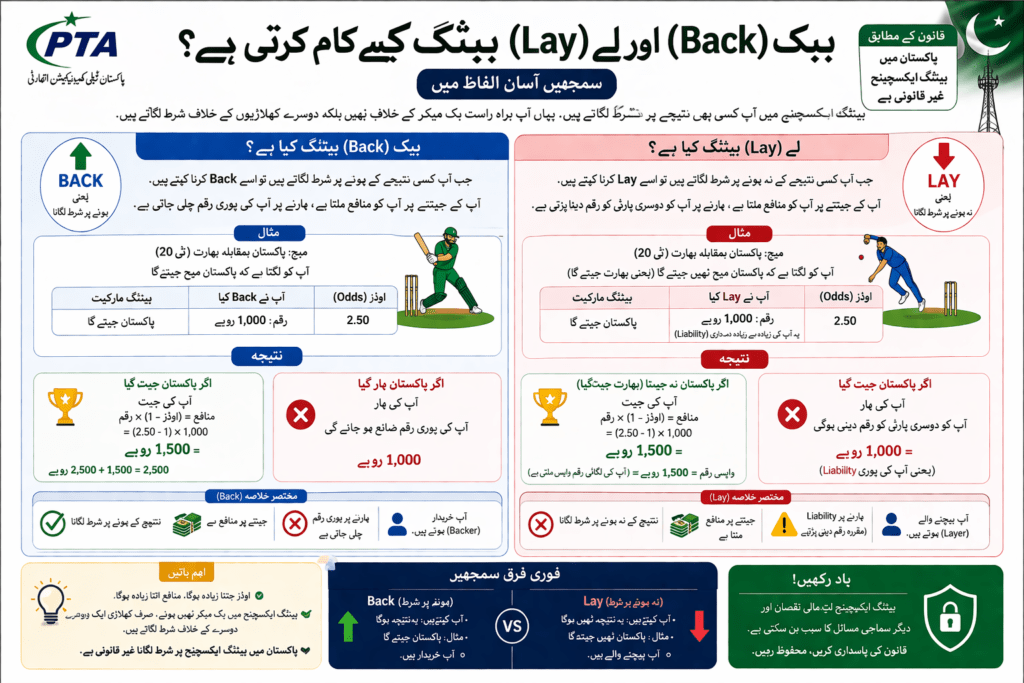
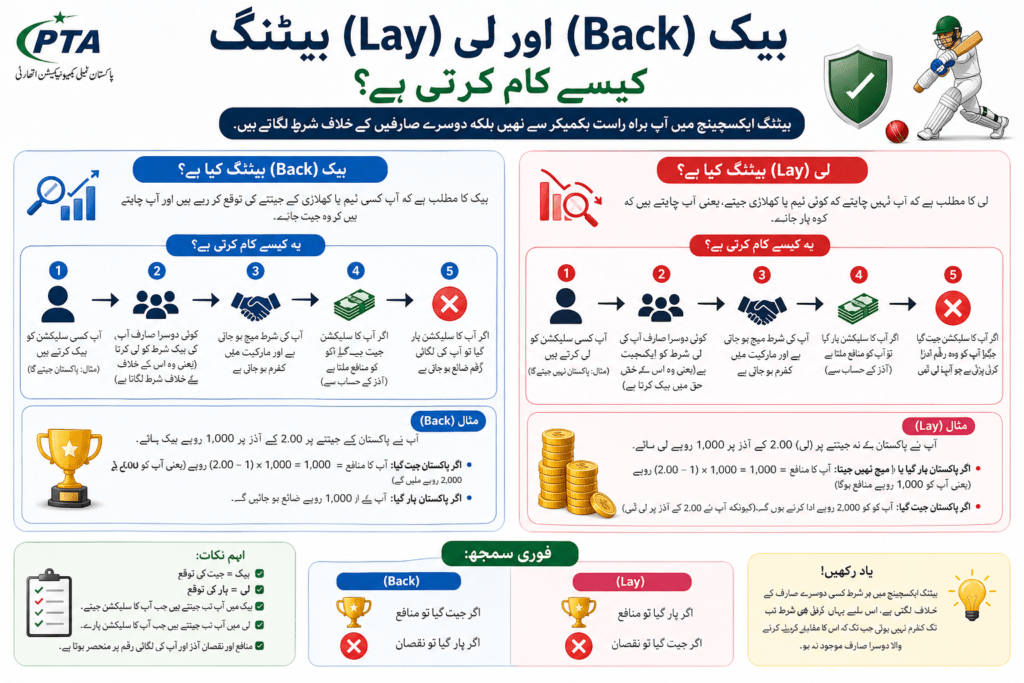
Backing is the most intuitive part of the exchange. When you “Back” an outcome, you are asserting that the event will happen.
Decimal Odds vs. Probability
In 2026, almost all global exchanges use Decimal Odds. This format is superior for calculating potential returns quickly.
-
Calculation: $Stake \times Odds = Total Return$
-
Example: A 5,000 PKR back bet at 2.50 odds returns 12,500 PKR (7,500 PKR profit + your 5,000 PKR stake).
The Psychology of Backing
When backing on an exchange, you aren’t just looking for a winner; you are looking for Value. If you believe a team has a 60% chance of winning, but the exchange odds are 2.20 (which implies a 45% chance), you have found “Value.”
3. Lay Betting: The Power of the “Bookmaker”
Lay betting is what defines the exchange experience. When you Lay, you are betting against an outcome. You win your bet if the outcome does not happen.
When do you Lay?
-
Laying a Win: You believe a specific team will lose or the match will end in a draw.
-
Laying a Draw: You believe one of the two teams will win, but you don’t care which one.
-
Laying a Score: You believe a match will not end 0-0.
The Role of the “Layer”
As a “Layer,” you are effectively acting as the bookmaker. You are offering odds to other users. If their “Back” bet wins, you are responsible for paying them their profit. This brings us to the most critical concept in exchange trading: Liability.
4. Deep Dive: Understanding and Calculating Liability
Liability is the amount of money you are “liable” to pay out if your Lay bet loses. It is not the amount you stake; it is often much higher.
The Liability Formula
Case Study: Laying India in a T20 Match
Imagine India is playing Australia. You believe India is overvalued at odds of 4.0. You decide to Lay India for 1,000 PKR.
-
The Scenario: A backer wants to bet 1,000 PKR on India at 4.0. You accept that bet.
-
If India Loses or Draws: You win the backer’s 1,000 PKR stake.
-
If India Wins: You must pay the backer their profit.
-
Calculation: 1,000 \times (4.0 – 1) = 3,000 PKR.
-
Result: Your Liability is 3,000 PKR.
Crucial Safety Tip: At BetPro Exchange, your account must have the full 3,000 PKR in “available balance” to place this bet. This ensures the market is always fully funded and secure.
5. Market Liquidity and “The Gap”
Liquidity is the total amount of money “waiting” to be matched at various price points.
Why Liquidity Matters
If you want to back a team for 50,000 PKR, but there is only 10,000 PKR of liquidity at the current price, your bet will be “Partially Matched.” The remaining 40,000 PKR will sit in the system as an Unmatched Bet until another user “Lays” it.
The Spread
In high-liquidity markets (like the PSL or IPL), the difference between the “Best Back” price and “Best Lay” price is usually only 0.01 or 0.02. This is a “tight” market and represents the best value for users. In low-liquidity markets, the gap (the spread) is wider, increasing the cost of trading.
6. Advanced Strategy: Sports Trading and “Greening Up”
One of the primary reasons professionals use BetPro Exchange is to “Trade” the market rather than just bet on it.
Trading the Volatility
During a live cricket match, odds fluctuate after every ball.
-
The Strategy: You “Back” a team at 3.0 before the match starts.
-
The Shift: They hit two sixes in the first over, and their odds drop to 1.50.
-
The Trade: You now “Lay” that same team at 1.50.
-
The Result: Because you backed at a high price and laid at a low price, you have locked in a profit regardless of who wins the match. This is known as “Greening Up.”
7. Risk Management and Responsible Engagement
The power to “Lay” and “Trade” comes with significant responsibility. Because liability can be much higher than the potential win, disciplined risk management is mandatory.
2026 Professional Standards:
-
Stop-Loss Protocols: Decide at what odds you will exit a trade if the match goes against you.
-
The 5% Rule: Never let your total liability on a single event exceed 5% of your total bankroll.
-
Avoid “In-Play” Chasing: Live markets move fast. If you miss a price, wait for the market to stabilize. Never “chase” a price into a high-liability position out of frustration.
8. Frequently Asked Questions (FAQ)
Can I lose more money than I have in my account?
No. Exchange technology calculates your maximum potential loss (Liability) in real-time. If your balance cannot cover the liability, the order will be rejected.
Why was my bet only “Partially Matched”?
This happens when there wasn’t enough liquidity at your chosen price. You can either wait for the rest to be matched or cancel the unmatched portion and take the current market price.
Does the Exchange want me to lose?
No. Unlike a bookmaker, the exchange does not profit from your losses. They charge a small commission on net winnings. They want you to be a successful, long-term trader because that generates more market activity.
9. Conclusion: The Future of Exchange Trading
Backing and Laying are the twin engines of the modern sports exchange. By understanding the math of liability and the dynamics of liquidity, users can transform their sports engagement from a game of “luck” into a disciplined practice of “market analysis.”
At BetPro Exchange, we remain committed to providing the educational resources necessary to navigate these markets safely. We encourage all users to review our Responsible Gambling Policy and start with small stakes until the mechanics of “The Lay” are fully mastered.